Blog
Sat–Chit–Ananda: The Joy That Was Never Missing…
The experience of bliss or pure joy is not an excitement. And it’s not an ‘experience’ either. It is the quiet steadiness at the core of our being which is the foundation from which life flows. And life can only flow when we get out of the way. The problem is that most of the time we aren’t even aware that we are in the way.
I’d like to invite you to stop for a moment, close your eyes and consider a time in your life when things flowed along nicely. Intensify that memory so that the whole experience is vivid. Bring all the senses into play…the light, the sounds, how you felt, the quality of that moment. In one or two words describe the feeling.
Now remember a time when life wasn’t flowing. Maybe a particular situation triggered something inside of you. Take yourself back to that time and remember how you felt, mentally, emotionally, physically. And in a few words describe that feeling.
The very fact that you can remember all of this – the good and the bad – tells us that we store memories in our subconscious – mentally, emotionally and physically. But underneath all of those memories and the armouring that protects those raw emotions, is pure joy.
In yogic philosophy, there is a beautiful expression that captures this sense of pure joy: Sat–Chit–Ananda — often translated as existence, consciousness, bliss. It is not a poetic slogan or a spiritual mood. It is a description of our deepest nature.
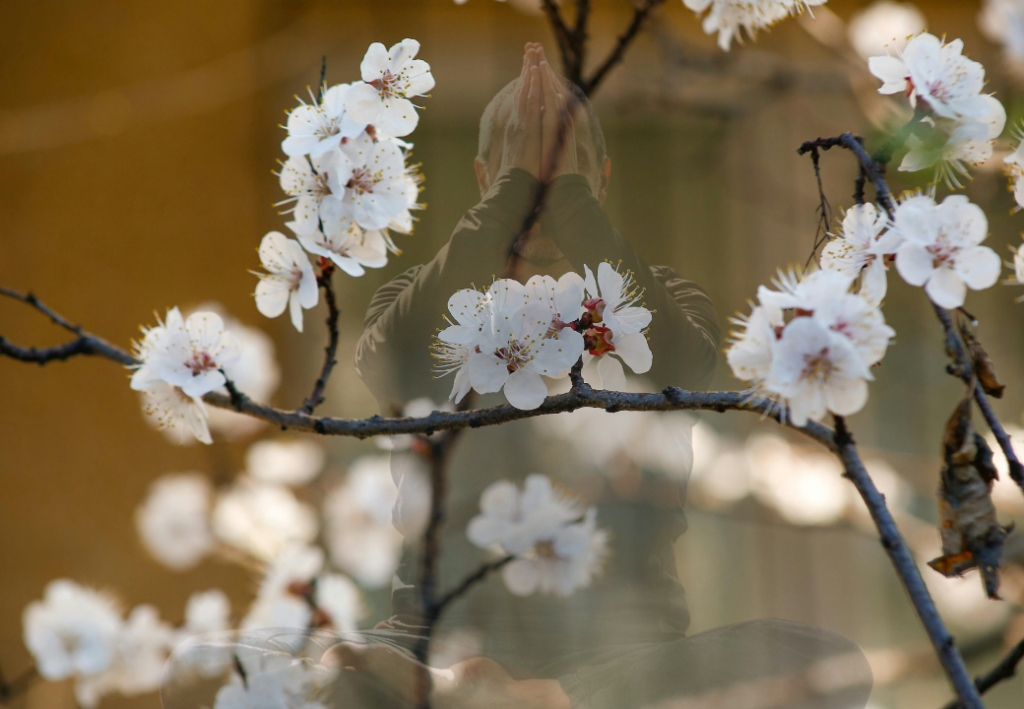
Spring is a wonderful time of year to contemplate this as the light shifts, the air softens, and something quietly begins again. Even though it never really stopped.
As we gather to celebrate spring through yoga, meditation, cacao and laughter, this ancient teaching offers a surprisingly grounded framework for understanding joy — not as something we chase, but as something we uncover layer by layer until eventually it reveals itself.
Sat — Existence: The Simple Miracle of Being
Sat means being, existence, truth. That which is. Long before leaves return to the trees, life is present in the roots. Winter never destroys existence; it simply quietens expression. Spring reveals what was already there.
In practice, Sat is felt through the body. When we stand in a grounded posture, breathe steadily, and feel our feet rooted to the floor, we are affirming something very simple: I am here.
Modern wellbeing research supports this emphasis on embodiment. Slow, conscious movement and breath awareness stimulate parasympathetic regulation — shifting the nervous system from vigilance to presence. In that settling, existence feels less like effort and more like quiet support.
Spring reminds us that being is enough. Growth follows naturally.
Chit — Consciousness: The Light of Awareness
If Sat is being, Chit is knowing. It is awareness itself — the capacity to observe thoughts, sensations and emotions without being swallowed by them. In yogic terms, consciousness is primary, and thoughts arise within it like clouds moving across the sky.
The Yoga Sutras of Patanjali outlines a progression from concentration (dharana) to meditation (dhyana) to absorption (samadhi). These are not esoteric achievements but refinements of attention. As awareness stabilises, identification with those fletting thoughts and feelings loosen.
In everyday language: we stop being inside every passing thought.
The practice of meditation helps this; we sit for a 20-30 minutes everyday and this watching of thoughts, feelings and emotions without being disturbed by them spills into our everyday life.
Imagine a flowing river – the river of life – as it flows along. We maintain awareness on this flowing river. And maybe some boats appear, there are reflection of clouds on the water, maybe some children throwing stones into the river. But we don’t get distracted by this…we aren’t interested in exploring inside the boats or getting in awe of the beauty of the cloud reflections or annoyed with the children for making too much noise. We simply watch the flow of the river. This is the practice of meditation.
Contemporary psychology calls this meta-awareness or mindfulness. Research consistently links it with improved emotional regulation and reduced rumination. But beyond outcomes, there is something more immediate: clarity.
March brings longer daylight. The literal increase in light becomes a metaphor. We see more clearly. We notice birdsong that winter masked. We feel subtle warmth on the skin.
Chit is this inner light. It allows us to witness change without panic and renewal without grasping.
Ananda — Bliss: The Quiet Hum Beneath Experience
The final element, Ananda, is often translated as bliss — though not in the sense of ecstatic fireworks. Ananda is deeper than excitement. It is contentment without cause. A subtle, steady warmth of being.
In the classical understanding, bliss is not manufactured. It is revealed when mental turbulence settles. If Sat is the ground and Chit the light, Ananda is the natural atmosphere when nothing is obstructing it.
Modern wellbeing research hints at this state. Positive emotions broaden perception and build psychological resilience. Practices that cultivate gratitude, connection and laughter increase endorphins and enhance social bonding. Nervous system regulation improves vagal tone and supports a felt sense of safety.
Yet none of these create joy, they reveal it.
Bringing Sat–Chit–Ananda to Life in Spring Practice
Our spring workshop on Saturday 28th March from 2pm weaves these three qualities into lived experience.
Cacao: Softening the Armour
Ceremonial cacao has long been used in ritual contexts to support heart-centred awareness. Physiologically, cacao contains theobromine, a gentle stimulant associated with vasodilation and mild mood elevation.
Symbolically, it invites softening. We do not drink cacao to become blissful. We drink it to lower defences — to listen inwardly. To feel.
Sat becomes embodied through warmth in the chest.
Chit sharpens as awareness turns toward sensation.
Ananda flickers as connection grows within the group.
Ritual itself opens the doorway to a depper meaning. When shared intentionally, it amplifies belonging — a cornerstone of wellbeing.
Laughter: Joy Without Permission
Laughter yoga research demonstrates measurable reductions in stress hormones and improvements in mood. More importantly, laughter bypasses the analytical mind. It is immediate. Physical. Disarming.
In moments of shared laughter, ego loosens its grip. The seriousness that winter sometimes accumulates begins to thaw. Ananda is accessed not through effort but through play.
Spring blossoms do not apologise for appearing. Joy need not either.
For those who are cringeing at the thought of this, my top tips for laughter are…laugh at yourself, laugh with others, and if all of that fails, laugh at me.
Movement: From Root to Expansion
Yoga movement becomes the bridge.
Grounded standing postures affirm Sat — the strength and dignity of being alive.
Slow transitions cultivate Chit — awareness of breath, weight, subtle sensation.
Expansive sequences and heart-opening shapes evoke Ananda — uplift without force.
The arc mirrors the season itself: Root. Awaken. Expand. Soften. Rest.
And in the final stillness, perhaps we notice something unexpected: when striving falls away, contentment remains.
Remembering Rather Than Becoming
Spring often encourages reinvention or rebirth — new goals, new bodies, new ambitions. Sat–Chit–Ananda offers a gentler invitation.
What if renewal is not about becoming something else? What if it is about remembering who we are?
Existence is steady beneath every season; Awareness is luminous and constant; and Joy is quietly present when we stop chasing it. Only when we stop chasing it.
Through yoga, meditation, cacao and laughter, we are not creating bliss. We are clearing the winter debris that obscures it.
Sat reminds us that we are here, Chit that we are aware and Ananda tells us that joy hums beneath experience.
Spring does not add anything essential, it simply reminds us.
Get in touch
I hold monthly themed yoga workshops on the 4th Saturday of each month, if you’d like to come along to The Joy of Spring Workshop on Saturday 28th March 2026 at 2pm, click here to find out more and book.
Feel free to get in touch if you’d like to explore yoga, meditation and shamanic healing on a deeper level.